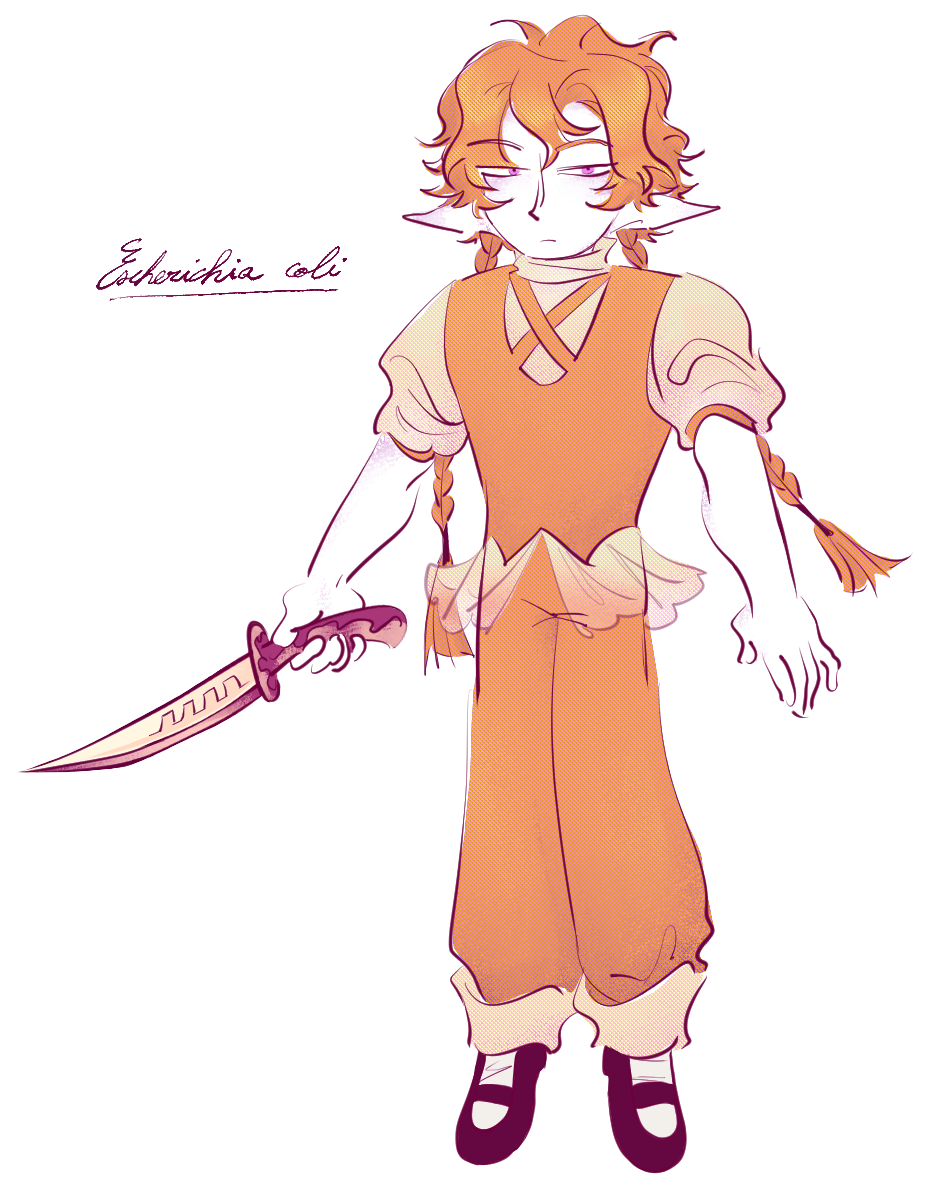
Escherichia coli is a rod living reclusively the intestinal tract of mammals. The most common member of the Enterobacteriaceae in spite of all, and in spite of not usually being a pathogen, he is viewed as a traitor in the bacterial gut community because of some Coli strain producing host-killing toxins. Coli is also tormented by his specialised pathogenic twins, the Shigella, who hate him and do all in their power to make his life worse.
An unwitting icon of molecular biology and microbiology, he is known by life sciences researchers around the world for his metabolic versatility and ease of manipulation. This situation, and the physical treatments that come along with it, greatly worsened Coli’s psychological state, making him feel dissociated from his other strains and unable to perceive the world through them.
Backstory
Coli was invited and helped to settle into the gut by other bacteria, notably Bacteroides “Tio” thetaiotaomicron. At the dawn of humanity, Coli found a plasmid, pInv, that confered him pathogenic powers over the gut 1 2. After settling into humans, Coli started occasionally using his pathogenic powers to settle clashes he’d have with other gut inhabitants. The more time went on, the more it hurt him to hurt his friends, and he ended up vowing to try to get rid of that plasmid. He eventually made up with other gut inhabitants and befriended many of them. At this point, the pathogenic Coli strains acted out of survival, not revenge.
One day, Coli is approached by a sly Yersinia pseudotuberculosis. Pseudotuberculosis wants to impress his mentor Mycobacterium tuberculosis, and he knows that his older brother, Yersinia enterocolitica, has pathogenic powers beyond his own. But Enterocolitica, endeared by Pseudotuberculosis’s perceived soft nature, does not let him in on the secrets of his pathogenic power, as he perceives the matter to be too “violent” for him. This is why Pseudotuberculosis comes asking Coli to keep an eye on Enterocolitica for him, to eventually determine what his powers come from. But instead of exposing his true motives, Pseudotuberculosis just pleads that he and Coli are not that estranged from one another (both Enterobacteriales), and that they should stick together as such. Coli accepts, without thinking much of it. Eventually, through Coli’s intel, the one to become Yersinia pestis learns that Enterocolitica’s major asset is another plasmid, pYV, through which he is able to forge Type 3 Secretion System weapons and the associated toxins. After secretly acquiring pYV from an independent source 3 4, Pestis starts outcompeting his brother in his niche, the mammal gut. Coli doesn’t realise that this has to do with the help he landed him.
Coli is approached once more by Pestis at the height of his pathogen carreer, when he is starting to have trouble with Deinococcus radiodurans. This time, Pestis tells Coli that he is looking for Radiodurans as a public threat. According to him, Radiodurans can “enter people’s hearts” and “change it” radically. Coli believes this and starts siding with Pestis for good against other commensals and mutualists of the gut, who support Radiodurans. To support Pestis, on his suggestion, Coli decides to exploit his pathogenic abilities for what he perceives as the common good. This slowly leads to pathogenic Coli strains unwaveringly supporting Pestis, and becoming nearly as agressive as him to host-supportive bacteria. Non-pathogenic Coli gets into big arguments with his former benefactor Tio, doubling down on his conviction that he’d rather kill humans trying to look for Radiodurans than let people’s minds be altered. The vast majority of the prokaryotes in the microbiota start looking to Coli as a traitor who didn’t keep his promise.
Eventually, non-pathogenic Coli stumbles upon Pestis rummaging through the exposed chromatin of a dead Radiodurans to eat. Coli comes to understand that Pestis was making him look for Radiodurans in an effort to find and aquire the genes behind his (super)natural abilities and. He realises that his inability to pin down and kill Radiodurans in particular was not caused by his own lack of skill, but by Radiodurans’s incredible toughness, which Pestis was deliberately misleading him about. Eventually, Pestis leaves disappointed, and when Coli approaches the corpse, he hears Radiodurans’s voice forgiving him. He realises that Radiodurans was helping people not to lose hope against Pestis.
The event causes a rift to form in Coli’s mind. As a non-pathogen, he feels shame. But his enteropathogenic selves, who built their entire new identities around fighting the gut microbiota and being loyal to Pestis, cannot accept to fall back into shame, themselves. Coli’s non-pathogenic and pathogenic selves (especially the Shigella, the most agressive of all) cannot get along at all anymore. The latter keep on supporting Pestis, while the former try to slowly detach himself from him. Because of his reputation and of the very dissimilar temperaments of his different incarnations, people don’t really know what to expect out of Coli anymore. After being domesticated as the reference lab bacterium, the mental dissociation he already suffered from got far more intense. To this day, Coli wonders if this is a punishment wrought upon him for being gullible and unwilling to understand his own community, and tries to seek forgiveness. Thankfully, not everyone has turned their backs on him yet, and his closest friends are supporting him as he contributes positively to life in the gut.
Personality
Coli’s personality fragmented very early on because of the pInv plasmid, and things suddenly took a turn for the worse when it was used by humans as a bacterial model for cloning.
A particular strain of E. coli can only perceive from the point of view of other strains of the same type. Although the same problem arises with other bacteria used in laboratories, the frequency with which E. coli is employed makes the situation a lot worse for him. Contrarily to other bacteria with similar phylogenetic history, the different types of Coli selves (different E. coli strains) are unaware of the whereabouts of the others at all. Coli’s mind is altered to a point where is somewhat difficult for him, even in his natural habitat, to think perfectly clearly. The different types of E. coli are often plagued by intrusive thoughts originating from other types.
If I write “Coli” without specifying the strain, I’m talking about non-pathogenic, commensal E. coli.
Non-invasive E. coli in vivo
Non-invasive Coli is quite reserved; he always aims to be reasonable. He considers life in the gut a gift, which is why he cares deeply for his hosts and the community of commensals around him. This Coli often keeps his words moderate. His gentle nature can appear harsher if necessary.
He seeks peace of mind, being the strain that comes closest to it, but without ever truly finding it. Indeed, although deprived of awareness of his other strains, wild Coli is plagued by intrusive thoughts, visions, nightmares… all day long. He tried to hide this from others for a while, but it eventually became an open secret.
He can nullify the toxic effect of the Shigella and prevent their invasion of intestinal tissue by producing cadaverin 5.
Non-invasive E. coli in vitro
The E. coli strains used in laboratories are constantly subjected to changes in their genomes, or to the production of proteins. Although they are not dangerous, the lab environment causes wild strains to suffer terribly, if not to the point of complete loss of reason. It is very difficult for them to think and form sentences, as their perception and consciousness are clouded by the background noise caused by evolution in the laboratory.
Commercial strains of E. coli are sometimes devoid of free will, driven solely by a survival instinct.
Invasive E. coli and Shigella
Invasive forms of Coli still morally affiliate with Pestis.
Pathogenic strains like EIEC (enteroinvasive), EHEC (enterohaemorragic), ETEC (enterotoxic), are neither friendly nor talkative. They are often looking to unleash their rage onto the first person they meet. They attack unprompted, but are too slow mentally to be master strategists; their raw power is what makes them threatening.
Shigella strains, despite having their own genus, actually phylogenetically fit better as subspecies/pathovar of E. coli 2 5 6 . The genus name remains for clinical purposes. Shigella strains like S. dysenteriae, S. flexneri, S. sonnei… all share the ability to produce the Shiga toxin. They are quicker-minded and a lot more expressive – the polar opposites of wild, non-pathogenic Coli. They are sadistic and will shout, scream, and come off as hot-blooded overall. They want to hurt the gut microbiota for turning on him as Coli, alongside killing humans with the same motives as Pestis.
Relationships
Bacteroides thetaiotaomicron
Coli feels very lucky that Tio has been looking out for him continuously, even at his worst, and has tried making compromises at every occasion. He regrets not having been very fair to Tio in the past.
Deinococcus radiodurans
Every self of Coli is in love with Radiodurans, including pathogenic strains. Interestingly, the Shigella, especially Shigella dysenteriae, are the most vocal about it, to a point where even Radiodurans himself has trouble matching the intensity. Coli himself is really shy about his attraction and want would’ve prefered keeping it a secret.
Lactobacillus casei
He knows that Casei envies him for being popular with humans, and he doesn’t like that. But at the same time, Coli feels like Casei doesn’t know him enough to fully grasp his issues with the gut.
Yersinia pestis
He feels betrayed and used by Pestis for his own gain. Coli feels like Pestis took advantage of his personal issues for his own gain. He holds him responsible for making his identity crisis worse. He also regrets telling on Enterocolitica.